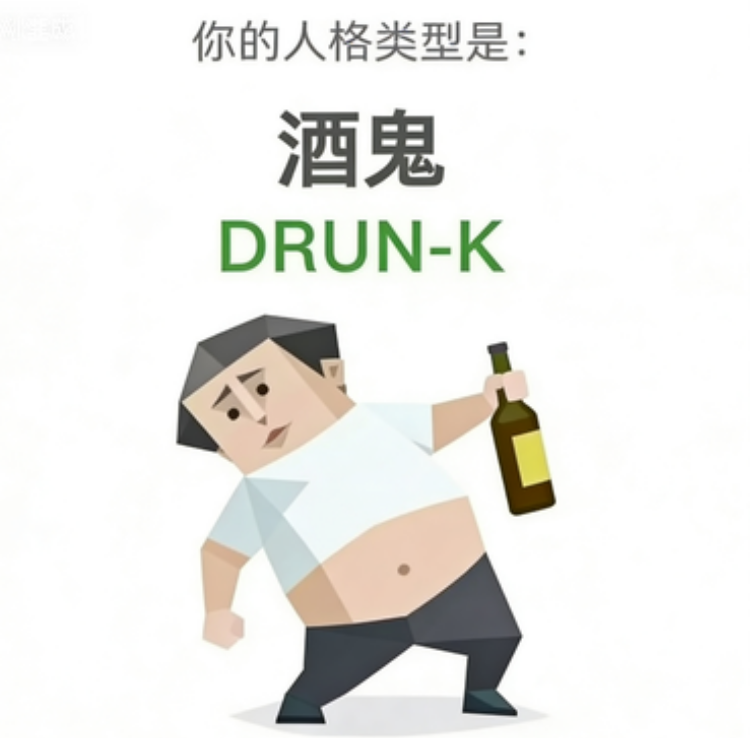
DRUNK Tipsy Firebrand
DRUNK belongs to the Special Types cluster. A tipsy firebrand whose intensity keeps spilling over the container. This cluster lives near the edge of the catalogue, where the framework deliberately leaves room for anomalies and jokes with teeth.
Overview
DRUNK (Tipsy Firebrand) usually reads through strong inner values and deep emotional investment. In the SBTI frame, that gives the type a recognizable posture long before the full story is explained.
When conditions are good, the type leans on strong inner values to stay coherent. Under pressure, identity haze and a strong need for closeness are more likely to become the friction points.
Strengths
- • Can turn strong inner values into a stable signature instead of a one-off performance.
- • Often holds situations together through deep emotional investment, especially when the room needs shape or direction.
- • When resourced, uses social initiative to move from instinct to repeatable follow-through.
Blind spots
- • Under strain, identity haze can start narrating the whole situation before new evidence arrives.
- • May protect itself with a strong need for closeness, even when a slower or softer move would work better.
- • If overloaded for too long, worldview tone can become the first place where style hardens into a trap.
Relationship pattern
- • Close relationships often carry both push-pull attachment and deep emotional investment at the same time.
- • The healthiest distance usually depends on whether a strong need for closeness is respected instead of pathologized.
- • Communication style tends to mix layered self-presentation with firm interpersonal boundaries, which shapes how safe the type feels while speaking honestly.
Work style
- • At work, the type usually shows a blend of risk-avoidant caution and rhythmic execution.
- • Decision rhythm leans toward deliberate pacing, so timing matters as much as confidence.
- • Rules, process, and change are filtered through situational flexibility and a baseline of defensive skepticism.
Growth path
- • Growth starts by noticing when self-definition stops being a preference and starts running the whole story.
- • A healthier version of DRUNK keeps values drive online while building more capacity around boundary distance.
- • A useful stretch is to keep strong inner values without treating defensive skepticism as destiny.
15-dimension profile
Confidence is present but still shaped by context and momentum.
Identity can blur under stress, leading to second-guessing and drift.
A strong inner value system gives direction and explains a lot of the push.
Trust and vigilance coexist, creating a noticeable push-pull rhythm.
Once engaged, it tends to invest real emotional energy and attention.
Closeness, responsiveness, and emotional merging feel especially important.
The default lens is guarded, skeptical, and ready to scan for failure.
Rules are usable, but adaptation is still part of the toolkit.
Meaning can flatten out, making effort feel more procedural than inspired.
The first move is often risk control rather than hunger for expansion.
The type usually thinks before acting, but does not always stall out.
Follow-through is present, though rhythm changes with timing and state.
It is easier here to open the room, start contact, and occupy visible space.
The type keeps a clearer perimeter and notices intrusion quickly.
Self-presentation is more layered, adaptive, and scene-aware.
Related types
FAQ
What makes DRUNK stand out? ▾
It usually stands out through the combination of strong inner values and deep emotional investment, which gives the type a clear first impression.
Where does DRUNK get stuck under pressure? ▾
Stress usually shows up first around self-definition and boundary distance. The fix is rarely a personality transplant; it is more often rest, perspective, and a better response window.